
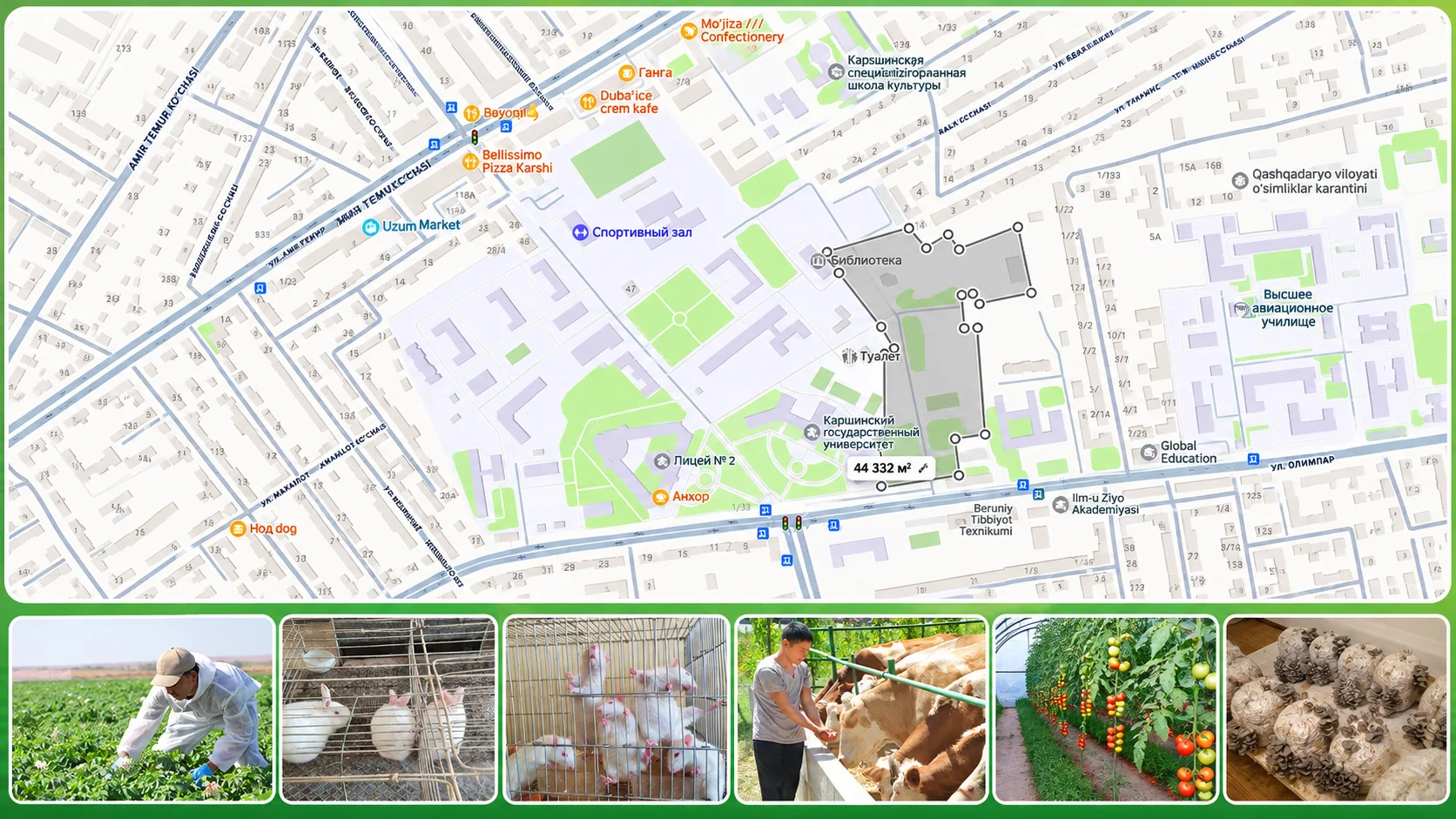
Karshi State University has implemented several conservation-oriented initiatives that integrate Information and Communication Technology (ICT) to ensure the sustainable management of plant, animal, and agricultural genetic resources. These programs contribute to biodiversity preservation, sustainable food production, and the enhancement of academic and research activities.Karshi State University has implemented several conservation-oriented initiatives that integrate Information and Communication Technology (ICT) to ensure the sustainable management of plant, animal, and agricultural genetic resources. These programs contribute to biodiversity preservation, sustainable food production, and the enhancement of academic and research activities.
Key conservation initiatives include:
• Main Campus Greenhouse: Located on the university's main campus, this facility focuses on the conservation and cultivation of tomatoes and cucumbers under controlled environmental conditions. ICT-based systems monitor temperature, humidity, and irrigation to ensure optimal plant growth. The greenhouse also serves as a practicum site for students, enabling hands-on learning in sustainable horticultural practices.
• Mushroom Greenhouse: Managed by university staff, this specialized greenhouse conserves and cultivates over 10 varieties of edible mushrooms and an equivalent number of medicinal mushrooms. Smart monitoring systems regulate light, humidity, and temperature to maintain ideal growth conditions. The project supports both scientific research and food sustainability goals, while fostering innovation in biotechnology and sustainable agriculture.
• Innovative Potato Field Conservation: A research-based field project where ICT-enabled soil and crop monitoring systems are used to enhance the sustainability and genetic diversity of potato cultivation.
• Rabbits and Rats Conservation: Located within the university's Biological Research Center, this facility is dedicated to the controlled conservation and breeding of small mammals for educational and scientific research. The unit currently maintains 26 rabbits and 32 rats, ensuring genetic diversity and ethical care in compliance with laboratory animal welfare standards. ICT-based monitoring systems regulate temperature, humidity, and light exposure, while automated feeding and health-tracking software support efficient animal care management. The facility serves as a practicum and research site for students in biology, veterinary medicine, and biotechnology, enabling hands-on training in animal behavior studies, nutrition experiments, and biomedical research.
These initiatives reflect Karshi State University's commitment to integrating ICT in conservation-related infrastructure, combining environmental stewardship, technological innovation, and practical education.
Conservation for Food Purposes: Located within the university's agricultural and research facilities, this unit is dedicated to the conservation and sustainable management of food-producing animal resources. The facility maintains poultry species, including chickens and as well as cattle, which contribute to educational activities, scientific research, and practical training in animal husbandry and agricultural sciences. The animals are managed under appropriate welfare standards, with regular monitoring of health, nutrition, and housing conditions. The facility supports studies related to livestock production, breeding, nutrition, and sustainable food systems while providing students with hands-on experience in animal management and agricultural practices. Through the conservation of these food-producing animal resources, the university contributes to agricultural education, food security awareness, and the preservation of valuable genetic resources.
The total area of 44,332 m² is designated for forest vegetation that contributes to research, teaching, and community engagement activities. This area supports the university's sustainability initiatives, biodiversity conservation, and educational programs related to environmental studies and ecosystem management.